
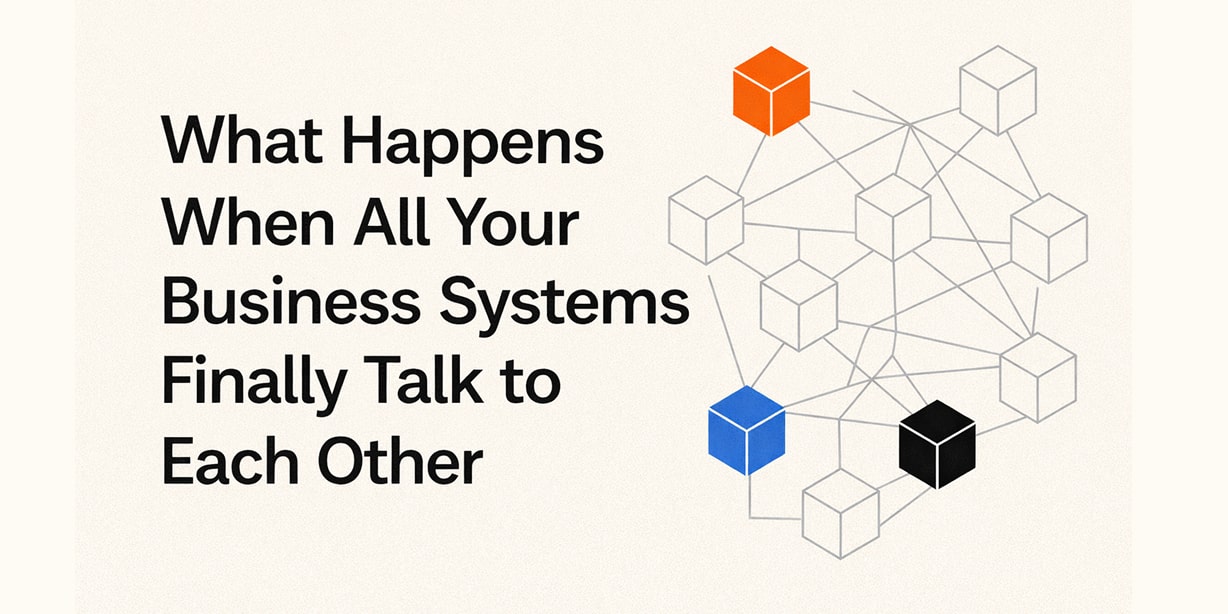
What Happens When All Your Business Systems Finally Talk to Each Other
Most businesses don’t have a people problem.
They don’t even have a technology problem.
They have a systems problem.
Sales uses one tool.
Marketing uses another.
Support has its own platform.
Finance lives in spreadsheets.
Operations are stitched together with manual work.
Nothing talks to anything.
And humans become the glue holding broken workflows together.
But something powerful happens when all your business systems finally talk to each other.
Everything changes.
The Silent Problem: Disconnected Systems
On the surface, things look fine.
Leads come in. Orders are processed. Clients are served.
But behind the scenes:
- Data is copied manually
- Updates are missed
- Teams work with outdated information
- Errors creep in
- Decisions take longer than they should
Every disconnected system adds friction.
And friction slows growth more than most businesses realize.
What It Means for Systems to Actually Talk
When systems talk to each other, they share context automatically.
This means:
- A new lead instantly appears in your CRM
- Sales updates trigger follow ups automatically
- Customer actions update support records in real time
- Payments sync with finance without manual input
- Reports update themselves across departments
No exporting.
No importing.
No copy pasting.
Just flow.
What Changes When Everything Is Connected
Clarity Replaces Guesswork
When data flows freely, teams stop arguing about numbers.
Everyone sees the same truth in real time.
Decisions become faster and more confident.
Speed Becomes the Default
Processes that once took days now take minutes.
Approvals move faster.
Follow ups happen instantly.
Customers get responses without waiting.
Your business starts moving at the speed of software, not people.
Errors Drop Drastically
Most mistakes come from manual handoffs.
When systems talk:
- Data stays consistent
- Nothing gets lost
- Human error disappears from repetitive tasks
Accuracy becomes automatic.
Teams Stop Doing Busy Work
Your team no longer wastes time updating multiple tools.
They focus on:
- Strategy
- Creativity
- Problem solving
- Customer relationships
Work becomes meaningful again.
Customers Feel the Difference
Customers may not see your systems, but they feel them.
They experience:
- Faster replies
- Smoother onboarding
- Fewer mistakes
- Better service
Connected systems create better experiences without extra effort.
This Is Where Automation Becomes Powerful
Automation alone helps.
But connected automation transforms.
When tools talk, automation can:
- Trigger actions across platforms
- React to real events
- Adapt to changing data
- Run end to end workflows without supervision
This is how modern businesses scale without chaos.
Final Thought
When your business systems finally talk to each other, work stops feeling heavy.
You stop managing tools.
You stop fixing gaps.
You stop acting as the middleman.
Instead, your business runs as one connected system.
Quiet. Efficient. Predictable. Scalable.
That is what modern operations look like.