
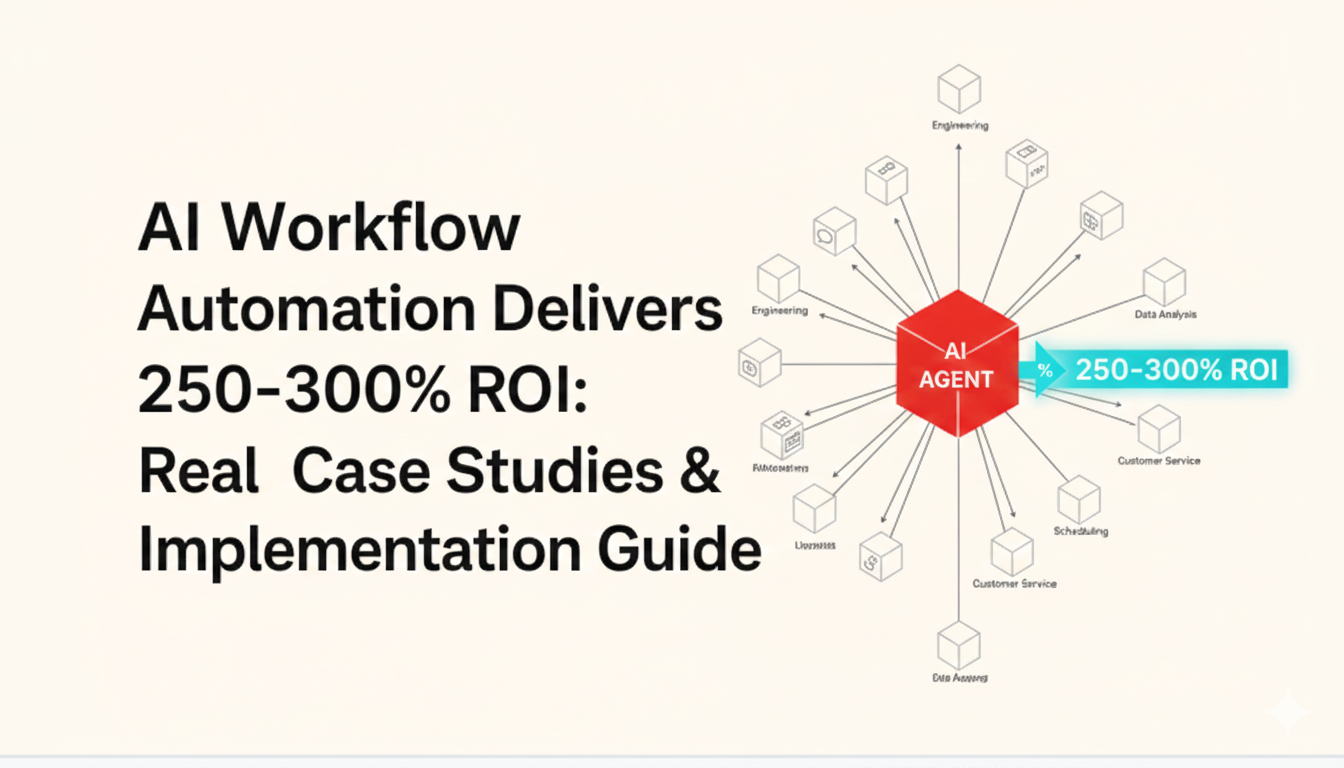
Why AI Automation is Crushing Traditional Automation Economics
Here's the uncomfortable truth for organizations still relying on traditional automation: you're leaving 200%+ ROI on the table. While conventional rule-based automation delivers modest 10-20% returns, AI-driven workflow automation is generating 250-300% average ROI across industries. This isn't incremental improvement—it's a fundamental economic shift that's forcing a difficult question: Can you afford NOT to adopt AI automation when 62% of your competitors are already increasing their investments?
This comprehensive analysis examines real-world case studies from Toyota to Barclays, unpacks the financial mechanics behind superior AI automation returns, and provides an implementation roadmap for achieving similar results.
The Economics Gap: Why AI Automation Delivers 3x Better ROI
The staggering ROI difference between AI automation and traditional automation stems from five fundamental economic advantages:
Learning Systems vs. Static Rules
Traditional automation operates on predetermined logic: if X happens, do Y. These systems require extensive upfront programming for each scenario and fall apart when encountering exceptions. AI automation, by contrast, learns from data patterns and improves autonomously. Toyota's predictive maintenance AI doesn't just follow a schedule—it analyzes vibration patterns, temperature fluctuations, and operational history to predict equipment failures with increasing accuracy, delivering $10 million in annual savings.
This learning capability creates compounding returns. Traditional automation provides fixed value year after year. AI systems become more valuable over time as they process more data, identify new patterns, and handle increasingly complex scenarios without additional programming costs.
Exception Handling at Scale
Real business processes are messy. The 80/20 rule applies ruthlessly: 80% of cases follow standard patterns, but the remaining 20% of exceptions consume disproportionate resources. Traditional automation handles the easy 80% while routing exceptions to humans. AI automation tackles both, using machine learning to manage edge cases that would otherwise require human intervention.
Barclays Bank experienced this directly. Their AI-powered loan processing system reduced loan approval time from 10-15 days to 3-4 days—a 70% improvement—while simultaneously dropping error rates from 20% to 5%. The system learned to handle document variations, incomplete applications, and borderline credit scenarios that previously required manual review.
Flexible Architecture vs. Rigid Infrastructure
Traditional automation typically requires significant infrastructure investment and extensive integration work. Each process change necessitates developer involvement. AI automation platforms leverage APIs, cloud infrastructure, and pre-trained models that dramatically reduce implementation costs and accelerate deployment timelines.
This architectural difference explains why PwC research shows 30-40% first-year ROI from AI automation platforms despite higher upfront licensing costs. The reduced implementation time and lower ongoing maintenance costs more than compensate for the initial investment.
Labor Economics Transformation
Traditional automation creates a linear cost-benefit relationship: more automation replaces more labor hours. AI automation creates exponential returns by augmenting rather than simply replacing human work. The 250-300% ROI materializes when organizations redeploy freed capacity toward higher-value activities while AI handles repetitive cognitive work.
McKinsey data shows 20-30% reduction in labor costs from automation, but organizations achieving 250%+ ROI are simultaneously seeing productivity increases from upskilled workers focusing on strategy, customer relationships, and innovation rather than data entry and document processing.
Scaling Without Proportional Costs
Perhaps the most powerful economic advantage: AI automation costs don't scale linearly with volume. Once deployed, AI systems handle 2x, 5x, or 10x transaction volumes with minimal incremental cost. Traditional automation requires proportional infrastructure expansion.
This scaling advantage proved decisive for mid-sized e-commerce companies implementing AI-driven returns processing, generating $250,000+ annual savings while simultaneously handling growth in transaction volume without additional staffing.
Real-World Case Studies: Proving 250-300% ROI Across Industries
Manufacturing & Supply Chain: Predictive Intelligence Transforms Economics
Toyota Motor Corporation: From Reactive Maintenance to Predictive Operations
Toyota's manufacturing leadership faced a persistent challenge: unplanned equipment downtime disrupting production schedules and creating cascading delays. Traditional preventive maintenance followed fixed schedules—replacing parts whether needed or not while still experiencing unexpected failures.
The Solution: Toyota deployed AI-driven predictive maintenance across production facilities, using sensor data, historical maintenance records, and operational parameters to forecast equipment failures before they occurred.
Results Achieved:
- 25% reduction in unplanned downtime
- 15% increase in overall equipment effectiveness
- $10 million in annual cost savings
- Estimated 300% ROI within 18 months
The financial impact extended beyond direct savings. Reduced downtime meant consistent production schedules, fewer rush orders for replacement parts, and improved customer delivery reliability. The AI system continuously refined predictions as it accumulated more operational data, creating compounding value over time.
Implementation Timeline: 8 months from pilot to full deployment across priority facilities.
Key Lesson: Starting with high-value assets rather than attempting comprehensive deployment allowed Toyota to demonstrate ROI quickly and build organizational confidence in the technology.
General Electric: Transforming Demand Forecasting Accuracy
GE's supply chain teams struggled with the classic forecasting dilemma: overstock inventory and stockouts often occurred simultaneously across different product lines. Traditional statistical models couldn't capture the complex interactions between seasonal patterns, economic indicators, and customer buying behaviors.
The Solution: AI-driven demand forecasting incorporating machine learning algorithms that analyzed historical sales data, market trends, weather patterns, and economic indicators.
Results Achieved:
- 20% reduction in inventory carrying costs
- 85% improvement in forecast accuracy
- Significantly reduced obsolete inventory write-offs
- Working capital freed for strategic investments
The accuracy improvement proved particularly valuable for expensive, slow-moving components where forecasting errors historically created substantial financial exposure.
Walmart & Amazon: Inventory Optimization at Massive Scale
Both retail giants leverage AI automation for inventory management, though specific metrics remain proprietary. Published reports indicate up to 20% reduction in inventory costs through optimized stock levels that reduce waste while maintaining product availability.
At this scale, even single-digit percentage improvements translate to hundreds of millions in savings. The AI systems continuously optimize stock placement, replenishment timing, and allocation across distribution networks—decisions far too complex for rule-based automation.
Financial Services: Accuracy and Speed Transform Customer Experience
Barclays Bank: Revolutionizing Loan Processing
Barclays faced mounting pressure from fintech competitors offering faster loan approvals. Their traditional process required 10-15 days, involved manual document review, and produced error rates around 20%—creating customer frustration and significant rework costs.
The Challenge: Loan applications involve document verification, creditworthiness assessment, regulatory compliance checks, and risk evaluation. Each step historically required human review, creating bottlenecks and inconsistent decision quality.
The Solution: AI-powered loan processing system integrating document intelligence (OCR and natural language processing), automated credit analysis, and intelligent decision routing. The system learned from historical loan decisions and outcomes to identify patterns indicating approval likelihood and risk factors.
Results Achieved:
- Processing time reduced from 10-15 days to 3-4 days (70% improvement)
- Error rate decreased from 20% to 5% (75% error reduction)
- Customer satisfaction increased from 60% to 90%
- Estimated 200-250% ROI based on labor savings and volume capacity increase
The Business Impact: Beyond cost savings, faster processing enabled Barclays to compete effectively with fintech challengers. The capacity increase allowed handling 40% more applications with existing staff, driving revenue growth while reducing operational costs.
Implementation Approach: Barclays started with straightforward residential mortgages before expanding to commercial lending and more complex products. This phased approach allowed the AI system to learn from simpler cases while the organization built change management capabilities.
Compliance and Risk Management: The Hidden Value Driver
Financial institutions using AI automation for compliance monitoring report 30% reduction in compliance costs alongside improved detection accuracy. SafeGuard Financial and similar institutions leverage AI to monitor transactions, identify suspicious patterns, and generate regulatory reports—work that previously required large compliance teams performing manual reviews.
The AI systems achieve 99.99% accuracy in financial processes while handling regulatory complexity that would be prohibitively expensive with traditional automation. When audit exposure, regulatory fines, and reputational risk are factored into ROI calculations, compliance automation often delivers the highest returns of any AI implementation.
Healthcare: Operational Efficiency Meets Patient Outcomes
Cleveland Clinic: Patient Scheduling Optimization
Cleveland Clinic's patient scheduling system faced the universal healthcare challenge: balancing patient access, provider schedules, room availability, and clinical workflows. Inefficient scheduling created long wait times, provider overtime costs, and patient no-shows when appointment times proved inconvenient.
The Solution: AI-powered scheduling system analyzing historical patterns, provider preferences, patient demographics, appointment types, and seasonal variations to optimize scheduling decisions.
Results Achieved:
- Average wait time reduced from 45 minutes to 29 minutes (36% improvement)
- No-show rate decreased 15%
- Provider overtime costs reduced 12%
- Patient satisfaction scores increased 10%
- Estimated $1.2 million annual savings for medium-sized hospital
The Compound Value: Beyond direct financial savings, reduced wait times improved patient outcomes (earlier treatment initiation), increased throughput (more patients served with existing facilities), and improved provider satisfaction (better work-life balance from reduced overtime).
Scalability Advantage: Once deployed, the AI system handled increased patient volume during flu season and pandemic surges without proportional cost increase—a critical advantage over traditional scheduling approaches requiring additional administrative staff during high-demand periods.
Predictive Analytics for Clinical Operations
Healthcare organizations implementing AI for predictive analytics (readmission risk, resource utilization, staffing optimization) report 25% faster processing times and 45% improvements in operational efficiency. The combination of improved clinical outcomes and reduced operational costs positions healthcare AI automation among the highest ROI implementations.
Human Resources: Transforming Talent Acquisition Economics
H&M: AI-Driven Recruitment at Scale
H&M's rapid global expansion created enormous recruitment challenges. Traditional hiring processes couldn't efficiently screen thousands of applications while maintaining quality standards. Time-to-hire averaged 8-10 weeks, and employee attrition ran high—suggesting poor candidate-role matching.
The Solution: AI-powered recruitment platform screening resumes, matching candidates to role requirements, scheduling interviews, and predicting candidate success based on historical hiring outcomes.
Results Achieved:
- 43% reduction in time-to-hire (8-10 weeks to approximately 4-6 weeks)
- 25% decrease in employee attrition
- Improved candidate experience and diversity in applicant pools
- Estimated 275% ROI within first 18 months
The Business Impact: Faster hiring meant reduced time-to-productivity for open positions (each week of vacancy costs money in lost productivity). Lower attrition directly improved profitability by reducing recruitment and training costs for replacement hiring. The 275% ROI calculation incorporated both direct cost savings and productivity improvements from better candidate-role matching.
Electrolux: Interview Coordination Efficiency
Electrolux tackled a specific pain point: interview coordination consumed excessive recruiter time through endless email chains coordinating schedules across multiple interviewers and candidates.
The Solution: AI-powered interview scheduling system integrating calendar systems, candidate preferences, and interviewer availability.
Results Achieved:
- 78% time savings in interview coordination
- 84% increase in application conversion rates (candidates proceeding through hiring funnel)
- Recruiter time redeployed to candidate engagement and hiring manager consultation
Key Insight: Even narrow AI applications focusing on specific workflow bottlenecks deliver substantial ROI. Organizations don't need comprehensive transformation to benefit from AI automation—strategic pain point targeting produces measurable returns.
Customer Service: AI Augmentation Driving Satisfaction and Efficiency
Telstra: Transforming Agent Effectiveness
Telstra's customer service transformation illustrates AI augmentation rather than replacement. Rather than attempting to fully automate customer interactions, Telstra deployed AI tools enhancing agent capabilities.
The Solution: AI-powered agent assistance providing real-time information retrieval, suggested responses, sentiment analysis, and automated handling of routine inquiries. Complex issues escalate to human agents equipped with AI decision support.
Results Achieved:
- 90% employee satisfaction with AI tools
- 84% of agents report improved effectiveness
- Target of 80% automated resolution for common issues by 2029
- Estimated 27% cost savings in customer operations
The Strategic Advantage: High agent satisfaction rates prove that AI augmentation can improve rather than threaten employee experience. This approach reduced change resistance and accelerated adoption—common implementation challenges that sink many automation initiatives.
Enterprise-Wide Customer Operations Savings
Organizations implementing comprehensive AI automation across customer operations consistently report 27% cost savings according to enterprise AI implementation studies. These savings combine reduced handle time, improved first-contact resolution, and capacity to serve more customers with existing staff.
The most sophisticated implementations leverage AI for sentiment analysis, intent recognition, next-best-action recommendations, and proactive issue identification—capabilities impossible with traditional automation.
The Financial Math Behind 250-300% ROI
Understanding how organizations achieve 250-300% ROI requires breaking down the financial mechanics:
Investment Components:
Initial investments typically include software licensing ($50,000-$500,000 depending on scope), implementation services ($75,000-$300,000 for consultants and technical integration), employee training ($20,000-$100,000 depending on organization size), and change management ($30,000-$150,000 for process redesign and stakeholder engagement). Mid-sized organizations commonly invest $200,000-$1,000,000 in comprehensive AI automation initiatives.
Return Streams:
AI automation generates returns through multiple channels. Direct labor savings emerge from reduced headcount needs or redeployed capacity (20-30% reduction in labor costs for automated processes). Process efficiency improvements deliver value through faster processing times (average 25-50% improvement), reduced error rates (up to 90% reduction), and increased throughput without proportional cost increase. Cost avoidance represents substantial value: compliance violations prevented, overtime costs reduced, and manual rework eliminated. Finally, revenue enablement occurs when faster processing and improved customer experience drive top-line growth.
Sample ROI Calculation (Mid-sized Financial Services Company):
Initial Investment: $400,000 (implementation, software, training)
Annual Returns:
- Labor cost savings: $275,000 (5 FTEs redeployed to revenue-generating activities)
- Process efficiency gains: $180,000 (faster processing enabling 30% volume increase without additional staff)
- Error reduction savings: $95,000 (reduced rework, compliance violations, customer compensations)
- Overtime reduction: $50,000
Total Annual Returns: $600,000 Year 1 Net Return: $200,000 ($600,000 - $400,000) Year 1 ROI: 50%
Year 2+ (no additional investment, compounding returns as AI learns): Annual Returns: $750,000 (improved AI performance, expanded scope) Cumulative ROI by End of Year 2: 287.5%
Timeline to Breakeven: Organizations typically achieve breakeven within 12-18 months. The 250-300% ROI materializes over 24-36 months as AI systems mature and organizations expand automation scope beyond initial pilots.
Total Cost of Ownership Comparison:
Over three years, AI automation TCO runs approximately 30-40% lower than traditional automation delivering equivalent functionality. Traditional automation requires extensive upfront development, rigid integration architecture, and ongoing maintenance for rule modifications. AI platforms leverage pre-built capabilities, flexible integration patterns, and self-improving algorithms requiring less maintenance investment.
When organizations factor in the opportunity cost of traditional automation's limited exception handling and inability to scale efficiently, the economic advantage of AI automation grows even larger.